Featured

Allow me to introduce myself…

It is an act of infinite optimism.

— Gilda Ragner

My name is Mia and I am a mother, a business owner, a homesteader, a farmer, and a wife. These are not all the things that define me, but they are the parts of myself that I tend towards when I think about where I am in life, and what I am building towards. My husband and I started Crump Family Farms in 2018 in central Virginia. We live on 3.5 acres with 7 chickens, 2 dogs, and 1 baby girl. We work to cultivate a life we love, a life in which we have as much time together and time outside as possible. We can often be found in our garden, where we grow the majority of the vegetables our family eats. We are currently learning to can and jar produce, and to store root vegetables.

On this blog, I will share stories from the homestead, tails (sorry…) from the farm, adventures of motherhood, and my journey as a woman in agriculture and a female business owner. I believe in sharing stories and our human connection to each other, to the food we eat, and to the earth. My daughter is a warrior, an angel on earth, and I will share her inspiring story on this blog as well, because she is my “WHY”. She is the reason I do what I do, she reinforces my belief in good food from the earth, and in shopping local and small to shop morally.

Please subscribe to follow our journey, and for tips and tricks in homesteading, chicken keeping, farming, gardening, and business ownership. What an adventure it all is!

Rainbow Recipe

In these surreal times, there is much we can (and will!) say + share about our thoughts on how this pandemic has shone a bright light on the inequities of our food system. But, for today, in this post, we just want to throw a little sparkle at your home kitchen, and invite you to bring colors into your food by cooking with a rainbow mix of microgreens! See our post on how to grow your own microgreens at home, and grow yourself a rainbow by choosing a few varieties with similar grow rates and mixing them together in a flat! For your inspiration, our rainbow mix is kale + amaranth + purple mizuna. This mix boasts a huge dose of a variety of vitamins and minerals, as well as complete plant protein and high fiber content. Below, we are sharing a colorful, wholesome, and delicious recipe for all you home cooks in quarantine! May it brighten your day, fill your belly, and bring you together!

We would LOVE to see what you create! Post a photo of your delicious creation on Instagram and tag us @crumpfamilyfarms! Happy cooking! 

Rainbow Couscous
Cook tricolor couscous per the directions, add spices of your choice, and just a dash of chunky tomato sauce. We use garlic powder, turmeric, paprika, salt, and pepper.
Separately, saute your choice of a rainbow veggie medley. Here is what we use, sauteed with olive oil and a dash of white wine, plus salt and pepper:
Asparagus
Tomatoes (cherry or diced)
Fresh minced garlic
Fresh chopped onions
Broccoli florets and chopped broccoli stems
Cubed eggplant (cube, salt, let sit for ~10 min, and dab the moisture before adding to the sautee)

Put it all together:
Just as the couscous is fluffing up and finishing cooking, add your sauteed veggies and stir it all together. You can also add your choice of protein such as sauteed chicken or marinated tofu. Top with fresh rainbow microgreens for a vitamin boost and some added spicy flare, and enjoy

This is HOPE.

Today is the Day…September 18, 2019

Seven months ago, on a cold Friday in February, we took our four month old daughter to see the developmental specialist team at UVA. Her head was growing quickly, she was gaining weight slowly, and our regular pediatrician recommended seeing the specialist team to rule out anything serious.  That’s why we went there, to rule out anything serious.  They took an ultrasound of her brain, through her little baby soft spot on the top of her head. This was a preliminary measure as the least invasive way to decide if further testing was needed.  I remember holding her as they did the ultrasound, feeling carefree, thinking, Well, at least this will rule out anything scary.  I didn’t even know what scary could be.

The doctor we had seen on Friday called us on Saturday morning.  That old adage about doctors only calling on the weekends with bad news made my heart sink when I saw the number on my phone.  We sat down together, my husband and I, we put the phone on speaker, watched icicles drip off our roof through the window.  We cried.  She told us they saw fluid on her brain, that further testing was needed, that it was indicative of something called hydrocephalus, a word neither of us had ever heard before.  We stayed as calm and collected as a parent can on that kind of phone call.  We asked what this condition could mean for her future.  She told us to come in first thing Monday morning, pack a bag, and prepare to stay at the hospital.  

Seven months ago they told us our child might never walk, never speak, never play.  That last one is what broke my husband.  Through ten years of being together, I have never seen his face crumble, his body shake, the way it did when he thought about our tiny little baby never growing up to play.  

Seven months ago we kept our daughter asleep through a 45 minute MRI, which usually requires sedation.  We sat in the room with her, ear plugs in, the only way I can describe this experience is that we held her and rocked in our hearts and our minds.  We kept our connection with her, that sacred bond between a parent and an infant, and we kept her peaceful and asleep. The staff had never seen a baby go through a 45 minute MRI without sedation.

Seven months ago they gave us the results. They showed us images that shattered my heart, broke me into a million pieces of guilt, fear, anger, sorrow, anguish, desperation.  They talked about brain damage.  They talked about saving her life, for the first time we understood that her life was in danger, that she was hanging on and trying her hardest, but barely making it.

There is no way to describe the surreal experience of staying in the Pediatric Intensive Care Unit, the PICU.  By the end of our journey, the fact is we were luckier than most of the families there.  One nurse told us that about the half the babies and children in the PICU are there long term.  It hurts to walk the halls when the doors to the rooms are slightly ajar, to see tiny bodies hooked up to monitors, to listen to the constant beeps of leads that check heart rate, blood pressure, oxygen levels, and breathing 24/7.  It hurts to hear little cries through the night and to wonder why…did they have to get their blood drawn?  Are they afraid of the nurses?  Did their mom or dad have to leave to go to work just to pay the bills to keep their child as safe as they can possibly be?  It is a surreal existence in the PICU.  We were woken up every hour on the hour for neuro checks, we got used to the 7 am and 7 pm shift change and rounds, which my husband always stepped out to listen in on, as doctors described our daughter’s condition, the tests they had done so far, the next steps.  

And we waited.  Here’s what waiting means…Our tiny little baby wasn’t allowed to nurse for 14 hours straight, because we had to be prepared at a moment’s notice to operate.  She was on fluids through a tiny little IV, which made my heart hurt to look at.  When you’re in the PICU, you aren’t “on the schedule” the way you would be if you had an appointment for an MRI or a surgery, or anything really.  You wait for the MRI machine to be ready.  You wait for the scan to be read. You wait for answers, and sometimes, you don’t get them.  Sometimes you will never know why your child has cysts in her brain, just that she has them. You wait for results.  You wait for the pediatric sedation team to assemble, for the OR to be cleaned and ready, for the brain surgeon to get some sleep so he can be at his best to operate on your baby’s brain. These are the most surreal words:  To operate on your baby’s brain.

Seven months ago, that is what happened.  Our daughter had two brain surgeries over two days.  The first to connect a group of cysts in the center of her brain through something called fenestration…a fancy way to say “poking holes”.  Her surgeon is a literal superhero who flies around the world to third world countries to share his knowledge and his surgical tools, empowering more surgical heroes to do more for the brave warriors that they treat.  His baseline is to be the least invasive he can be while accomplishing the most he can accomplish.  His plan was to get the cysts to communicate as one, then put in a single shunt to drain the pocketed fluid to her digestive system through a permanent catheter. 

Seven months ago, when we asked our daughter’s surgeon about comparable cases, he talked about a toddler who had not developed “normally”, who was not walking or talking at three years old.  Essentially, we were told to prepare ourselves.  Something in me knew this was not going to be her story.  Through all of this, these last seven months, which have included monthly fast scan MRIs (no sedation required), monthly appointments with her neurosurgeon, multiple appointments with the developmental specialist teams, biweekly physical therapy appointments in our home to help her catch up in her gross motor development, and a final brain surgery two weeks ago to address one cyst that was anatomically unreachable during her first surgeries—somewhere in all of that, I held onto my faith.  Faith isn’t the right word actually.  Knowledge is the word.  I just knew.  When people said to prepare for the worst, even when my husband prepared himself, went to a dark place of sad possibilities, reconciled the potential reality of our future…even then I knew.  I claimed a victory. 


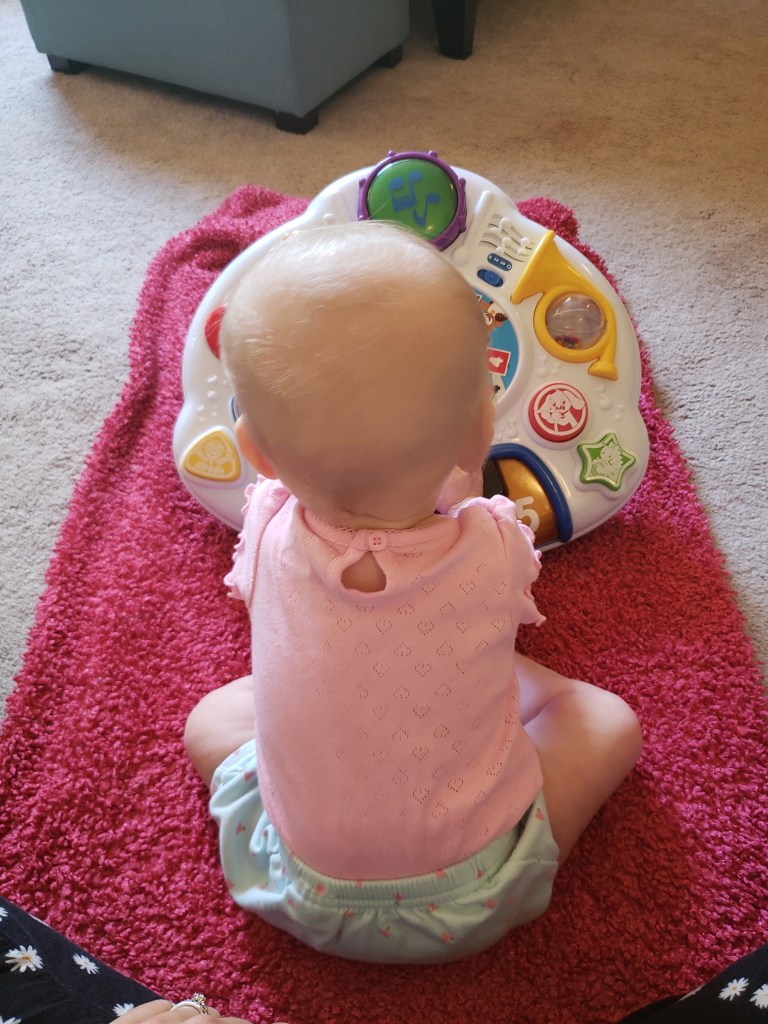
And today is the day. Today my fierce, strong, warrior child sat by herself to play.  A baby sitting for the first time is a magical moment for any parent, and I don’t discount that in the least. When doctors tell you to prepare for a child who will never have gross motor control, watching your baby sit up for the first time is something else entirely. It is a magical moment as it is for any parent, and it is hope. It is validation.  It is relief. It is triumph. It is everything. This huge leap in her motor skills is how she shows the world, the doctors, me, her dad, our family…that she is what I always knew she is…going to be just fine.  Not fine, extraordinary.  Against all the odds, and above all the expectations.  Extraordinary, fierce, and victorious.  And just in time for her first birthday.

“Brain Surgery”

I have chosen to share my daughter’s story on this platform for a number of reasons. First and foremost, I hope that her story may reach another parent experiencing similar trauma. I would want that parent to know, you are not alone in this heartbreak, and you are not alone in how you process this, whatever that looks like for you. Second, I have chosen to share her story here because she is my WHY. She is the reason I left the classroom to stay home, she is the reason I turned back to my oldest passion as a steward of the earth, she is the reason I believe in sustainable living practices and agricultural practices. My hope is that her story will lift hearts, and show that in all we do, we must consider the next generation. So, let us. Here is a look back at our first experience in the pediatric ICU in the winter of 2019, written a few months later in the spring of 2019, and shared with you now.

The week we were in the PICU, that cold, bitter week in February of 2019, on one of our many trips down to imaging for another MRI for our four month old warrior princess, the sweet and well-meaning technician said to us, “You guys are going to know this place like the back of your hand!” It was 2 in the morning.  “I never wanted to do that,” I said quietly, and I tried to smile.  My heart broke a little more.

This is what it’s like to have a child who is an extraordinary fighter. Every day is normal.  Every day I run my business, I play with my daughter, I read books to her, I roll on the floor with her, I breastfeed her, I take baths with her, I get up at night to change her diapers and feed her and snuggle her back to sleep.  Every day is normal.  Except I am on the lookout for her head swelling, her eyes crossing, her limbs seizing.  Every day is normal.

This is what’s like to have a child with a shunt, who fought fluid in her brain to become who she is, who didn’t grow for a month because she was battling to be alive.  It is watching her smile, listening to her talk, cheering when she accomplishes every single milestone. “Behind”.  “Delayed.” “At risk”.  “Failure to thrive.” These are the words they use.  Who are you talking about, I wonder, because it isn’t my baby.  My baby is fierce.  My baby is an angel on earth.

This is what it’s like to have a child who had two brain surgeries in two days.  It’s your heart shattering for the long hours she is in surgery.  It’s clutching her blanket and holding her in your heart.  I talked to her the whole time, I kept my connection with this human I grew, this little one whose soul I knew.  During her first surgery, I made everyone stop and pray, I could feel she was struggling.  Then I felt her energy come back as we prayed, visualized, meditated.  I was later told she had a brain bleed, which the surgeon was quickly able to correct and no damage was done.

This is what it’s like to have a child who was brought to us to teach us strength, resolve, grit, and unconditional love like no other.  It’s going to the grocery store with her snuggled up on me in the baby carrier. It’s working in the garden while she plays on the ground, it’s making dinner while she talks about her day in her baby babbles.  It’s watching her struggle and push through the extra work it takes to lift her sweet head.  It’s sitting in my faith that I see only a bright future.  It’s crying in my guilt and my anger.  

This is what it’s like.  It’s having the happiest baby in the world, the sweetest, most loving human I’ve ever known.  It’s being humbled every day by my daughter’s strength and bravery.  It’s being honored to be her mother.  It’s people showing up to love her, to express genuine concern, to surround us in light and love.  It’s struggling to understand WHY my child, why this precious soul?  But it’s also knowing that this little soul who chose me as her mother, this little soul is strong, powerful, fierce and gentle, and I am honored.

Graphing Your Garden

Since we started gardening seriously, we have kept a journal with all kinds of garden information…What types of seeds we order, first and last frost dates, planting dates, harvesting dates, proactive pest-prevention (all organic, of course), nutrients and fertilizers we have used, compost and compost tea we have made…everything that goes into our garden goes into our journal. If you garden, I cannot recommend enough that you journal! Make it yours, draw, write, doodle, glue…whatever you are “drawn” to (sorry…), but do it! You won’t regret it, and the future-you will be so thankful that past-you took notes!

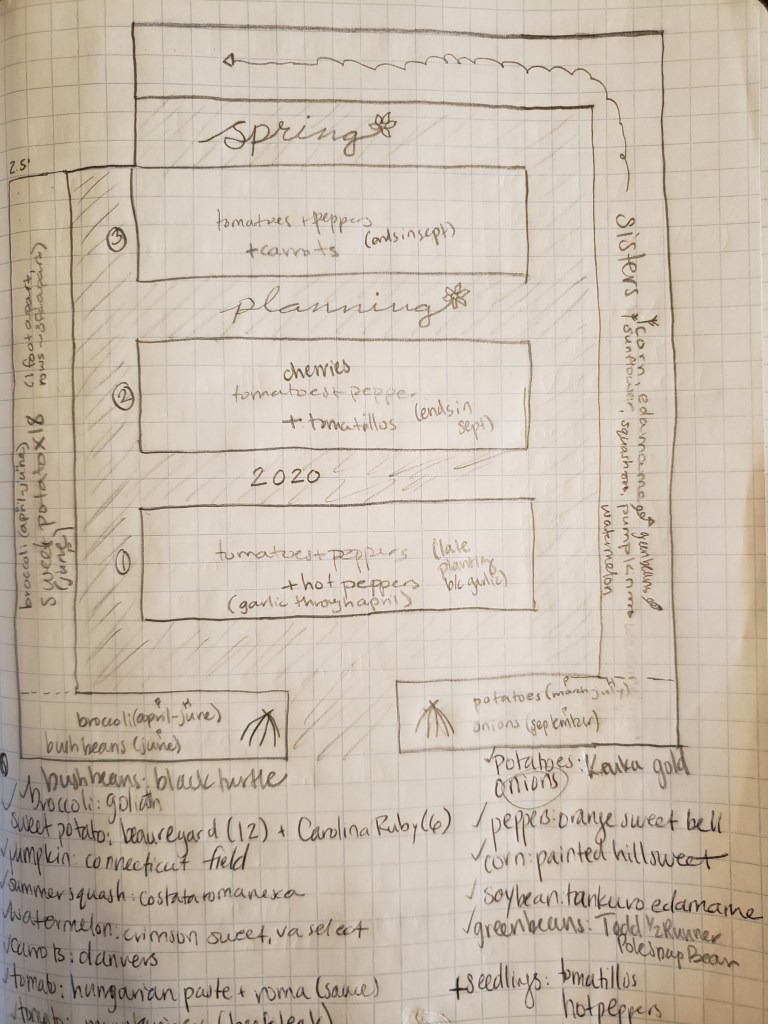
Every year as winter comes to a close, we enjoy sitting down to map out our spring garden, to sketch out a promise of new life, of bountiful nutrients for our family and friends. One day, when we expand beyond our micro farm into a full produce farm, these sketches will surely span for pages. For now, here is what we do, and I hope this may help our readers get a plan going for your spring garden!

If you have not started seeds indoors for transplanting, don’t despair! Simply find out your hardiness zone, and procure the appropriate seedlings. In Southwest Virginia (zone 6b), broccoli seedlings should already be in, and pepper and tomato seedlings should be going in within the next few weeks. We also did potatoes this year, and those went in at the end of March. If you haven’t started these seeds, support a local greenhouse or nursery during these trying times, a lot of them are doing curbside pick up! Stay safe and get your veggies planted! Next up, start seeding squash, pumpkins, watermelons, all the crawlers. In a couple weeks, it will be time to direct sow corn and beans. We are planning a version of the Native American three sisters this year…Corn, beans, and crawlers (squash varieties, melon varieties, and pumpkins). The corn acts as a shade for the crawlers, and a trellis for the climbers (beans). It is a gorgeous, symbiotic garden!

How to grow microgreens to boost your immune system

Earlier this week, I wrote a post about the nutritional benefits of magical microgreens. I also created an additional page on our website with a full list of the varieties we grow on the farm and their health benefits, and I shared this information on our Instagram. Today, I would love to share with you a simple method for growing microgreens at home, in any sunny location indoors, to bring these nutrients to your family. As we all do our best to practice social distancing, growing microgreens can be a lovely way to connect with plants and the earth from inside, and boost your family’s immune system with the tasty plants you will reap!

Some of the varieties we grow with the highest antioxidant values and immune boosting properties are: amaranth (also an ancient grain and a protein source!), beets (also a DNA repairer!), kohlrabi (also high fiber!), arugula (also good for your skin!), and basil (also antimicrobial and antibacterial!). All are delicious, beautiful, and offer many health benefits beyond a helping hand to your immune system. In the reality we are all sharing and adjusting to now, I thought it best to share some insight on how to grow these little buddies at home.

As a young child, I gardened with my grandmother and it is with her, in the quiet moments we shared in the garden, that I found my love and admiration of our mother earth and the amazing plants she grows. Now, as a farmer, I am constantly in awe of the power of plants to nourish our bodies, and the process of gardening as a meditative, calming nourishment for our mental health. With that in mind, I invite you to nourish your soul and your body by growing microgreens for your family!

Here is what you need:

Tray or other vessel. I use 10×20 seed trays, one with holes on top and without holes on bottom. If you don’t have these on hand, this is a great opportunity to recycle! Use an old yogurt container, a dejected cookie sheet, anything will do! Whatever you use, I suggest watering from the bottom (this is why I use one with holes and one without), because microgreens are quite delicate and don’t like to be watered from above.

Soil or other planting medium. A lot of folks use coco fiber, I haven’t tried this and can’t attest to it. I have played around with hemp mats, and though I have seen others succeed with this method, I found that they dried out too quickly. The best thing I have used is a soil specifically formulated as a seed starter. This way, it is has just the right amount of nutrients for these delicate babies, good aeration, and good drainage.

Light source. On the farm, we have a fully functioning indoor grow space using T5 fluorescent lights on shelves. You don’t need anything fancy to grow microgreens at home! Something like a little yogurt tub of micros can easily be grown in the kitchen window, just give it sun!

What to do: For basil, kohlrabi, arugula, and amaranth you can sow them directly after you’ve patted down the soil so it is quite compact in whatever vessel you’ve chosen. *The only difference here for beet seeds is that they need to soak for about 24 hours before planting, as they have very hard seed hulls.* Moisten the soil so it is fully saturated but no puddles are seen. Spread the seeds so they are dense enough to cover most of the soil, but not so dense that you risk blight or other diseases for your little plants. Mist the seeds with a hydrogen peroxide solution to inhibit mold growth. I use 4 cap fulls of hydrogen peroxide per 1500 mL of water. Cover the tray/vessel so it is in complete darkness. I use tin foil, you can also use another tray on top. *The difference here for beet seeds is that they need a layer of soil on top, while all other seeds do not. They also need a weighted dark period, so I use a tray stacked with scraps of wood to weigh it down during germination.*

Mist your seeds twice daily.*Except beets–just don’t touch them for about 6 days, then lift the weighted top and get ready for a magical, magenta surprise!* Make misting your seeds a relaxing part of your morning and evening routine! Kohlrabi takes about 4 days to be ready for light, arugula takes about 3, amaranth takes about 4, and basil takes about 6. You will know they are ready for light when the are about 2 inches tall. Fun fact: Basil seeds are mucilagenic, meaning they will form a slippery coating during germination, similar to chia seeds. This is a fun process to watch, especially if you have kiddos looking over your shoulder!

Harvest and enjoy! To be ready for harvest, kohlrabi takes about 4 days under light, arugula takes about 4 days, amaranth takes about 5, and beets take about 6. You’ll know your microgreens are ready when they have their first true leaves, or you can eat them at the cotelydon stage (the first two “leaves” that come out as they sprout up).

Farming + Wellness

As a global community, we are facing an unprecedented worldwide pandemic with COVID-19. It seems all our lives have changed drastically in one way or another within a week. I have struggled with how to address this surreal situation from a business perspective. As a small business owner, I won’t sugarcoat it–I panicked. I cried. But then a dear friend said, stop your crying and find five things to say thank you for. So I did and I will continue this practice, as I hope you may be inspired to do the same. When you see empty streets, unused buses, closed restaurants, it is easy to be filled with dread of what the future may hold, sadness for our current situation, desperation to cling to life as we knew it. But instead, I invite you to see all the emptiness and the “CLOSED” signs as signs of love. We are giving each other immense love and compassion when we stay home, to the best of our individual abilities, as much as possible. We are protecting each other and looking to a brighter future. Now, on to Farming + Wellness.

In the face of COVID-19, social distancing, and restaurant closures, I gave a lot of thought to door-to-door microgreens deliveries, something I had already been planning to set up as we launched our CSA this summer. I also thought about a pay-what-you-can system for families who find themselves suddenly and unexpectedly financially strapped. I thought about the ways I could bring microgreens to everyone in my community, because I believe in the vitamins and nutrients they provide, especially in these times as our immune systems can use all the help they can get. But, because I also believe social distancing is our best choice right now, I have decided instead to share some information I had already been working on putting together before COVID-19. I am sharing the power of microgreens below. I invite you to take a look, think about what might benefit your family, and start growing. I will post a quick how-to for counter top microgreens in the next few days. Now is the time to look at ways you can grow vegetables, full size or micro, for the health benefits of eating them, and the mental health benefits of growing them. Below you will find a few of our most common varieties on the farm, along with what they offer your body when you eat them. The health benefits are organized as “Facts” + “Extra Nutrients” + “Minerals” + “Vitamins”. You can also see the full version here.

Amaranth: ancient grain + complete plant protein + antioxidants + high fiber + folate, iron, magnesium, phosphorous, potassium, calcium + vitamins A, C, E 

Beets: DNA repair + oxygenates muscles + antioxidants + pectin helps remove heavy metals from the body + high fiber + iron, nitrate, folic acid

Mustard Varieties: superfood containing folate + manganese, potassium, copper, calcium phosphorus + vitamins A, C, K, E, B6

Sunflower Shoots: a complete plant protein, containing all of the essential amino acids + iron, potassium, magnesium, copper, phosphorus, zinc + vitamins A, B complex, D, E

Our Garden Plot Story

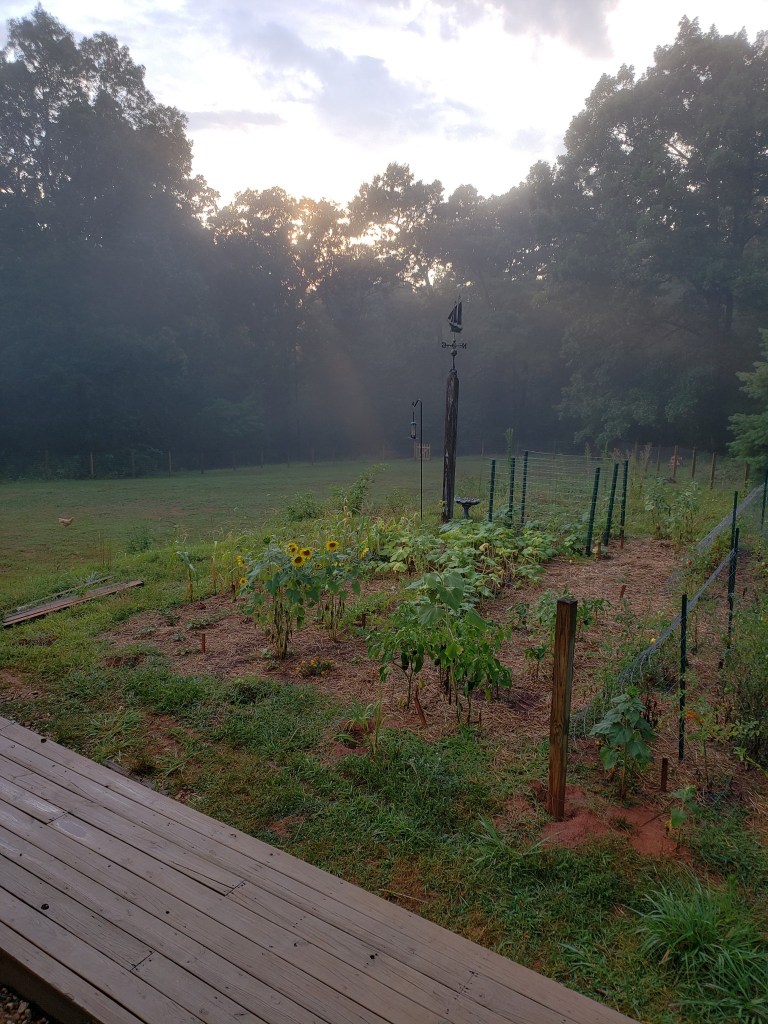
We have always been gardeners. We built a little garden in the middle of the city in San Diego. We built raised beds at a small rental house in Charlottesville. When we bought our home and finally moved out to the country, the first thing we jumped into was creating a garden plot. The little patch of earth that we steward as our family’s food garden is a treasured and meditative spot on the property for us. When we bought our home in the spring of 2018, this little plot was a messy, grassy, weed-ridden hill that had once been an above ground pool, then was a spot for a trampoline, and now was a neglected patch of earth. The first season we lived here, we planted what we could and did our best, but it was really quite a mess. We did manage to yield a nice crop of sweet potatoes, an abundance of tomatoes, some scraggly beans, a few squash plants, and sunflowers, along with a LOT of weeds, and a lot of unfortunate garden pests in unhealthy soil.

Over the past two years, we have spent a lot of time reinvigorating this patch of earth, which comes to about 500 square feet. Our first major renovation was tilling the grassy patch before planting those first sweet potatoes and tomatoes. But our major renovation to the garden came the summer of 2019, when Spencer took the time to dig out and meticulously measure beds. Tilling itself was a major debate for us, and is not the right choice for everyone–it wasn’t our first choice either. Tilling can disrupt the natural cycles of soil, the ecosystem below ground, and the root network that may be benefiting the soil and protecting it from erosion. We made this choice out of haste, and the need to get rid of grass and weeds quickly.

Now that we have learned more about regenerative gardening, I wish we could go back and take a season or two to layer the soil with cardboard (unmarked, of course), straw, compost, and other regenerative solutions. But, we are where we are. When Spencer dug out beds and created the beautiful garden we work in today, we were able to add some regenerating elements, and we did layer in all the things we missed out on when we decided to till.

The beds became a lasagna of straw, compost, AZ sand, peat moss, and top soil. Straw and peat moss aerate the soil, which is a must for the thick Virginia clay that we steward here. AZ sand adds essential nutrients to the soil to invigorate it and help it get ready to host plants. Compost does the same, while also adding dead plants, chicken manure, and spent beer malts from Spencer’s brewing back into the earth–a lovely cycle! Top soil we used to fill up the remainder of the space, and our top soil was broke up clay soil that had already existed.

I am proud of what we have built so far, but we are certainly still learning how to be responsible and sustainable stewards of the land, how to rotate crops, how to provide nutrients back into the soil. The beautiful thing about gardening and farming is that it is ever evolving, as the earth, and gives you grace to learn and grow.

Spring Garden Starts in the Snow

Preparing for your spring garden starts in the wintertime (well, autumn really, but you see the fruits of your labor in the wintertime). I have always found the activity of mapping our future garden to be so cozy and peaceful. I like to snuggle up by the fire with my garden notebook and get planning. I always write in pencil because things tend to change as the planning gets growing (sorry…)

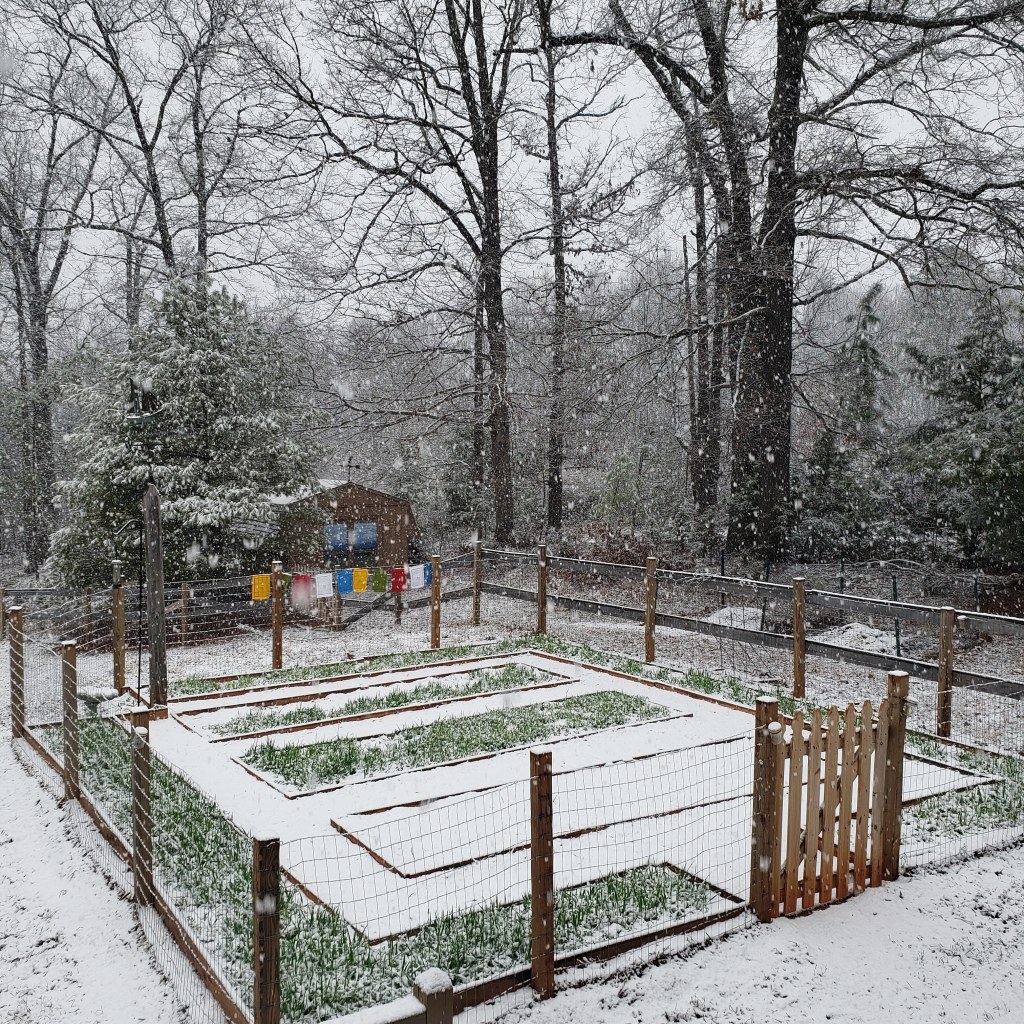
Our outdoor beds are currently a beautiful, magical mix of cover crop, baby garlic just poking through the soil, and…snow. Glorious snow and the things it does for us! I love the stillness and quiet that settles on the forest after a good snow, the sprinkling tinkling sound of the snow as it falls on the trees and hedges. Of course, this time of year is also a busy time underground. As frost settles upon us, our spring flower bulbs are pondering their emergence in a few months. Our garlic is stretching itself for some winter sun above soil, but below ground is building itself into juicy, spicy cloves. There is no garlic like fresh garlic! If you’re doing a winter garden, you may even have some broccoli or spinach hanging around.

We skipped a winter garden this year in lieu of cover crop. It was time our soil got a boost after working so hard for three of the four seasons in 2019! Ours is a tailored mix from our favorite local homesteading store. It is red clover, oats, hairy vetch, and tiller radish. Each has a purpose. The red clover provides a nice little foraging cover for our friendly critters, while supplying Nitrogen into the soil for the future crops. Plus, if winter leaves you with any usable red clover, it is a medicinal herb that can be used in teas or salves. Oats help to recycle nutrients and prevent erosion. Hairy vetch is a major Nitrogen supplier as well, and also improves soil tilth, or the “looseness” of your soil that will making spring planting easier. Finally, my favorite little science nugget of the cover crop quartet…tiller radish! Tiller radish puts out large, conical tap roots, that will actually end up dying and decomposing over the course of winter. Thus, when you remove your cover crop in the spring, or mulch it, the tiller radish has left you some lovely, perfectly formed pockets in which to deposit nutrients, green sand, or anything your soil needs. What a great garden buddy!

Cover crops like these should be planted in mid August to mid September, depending on your zone. We got ours in toward the end of August this year, and I think next year we will plant a little earlier with the hopes of the cover crops growing a little taller. They came in full and lush, but only ever got to be about 6 inches tall. The garden beds remind me of giant microgreen trays from our indoor farm!

As you read this post, I hope it has helped you to think about ways to invigorate your soil for the spring. Essentially, cover crops are like vitamins for your soil, and the best part is, they do all the work for you! Coming soon…an informational post on planning your spring garden using graph paper!

A Reflection on My First Year of Motherhood

I originally wrote this entry privately in August of 2019, about two weeks before my daughter had her third brain surgery. I share it with my readers now as we all close the door on 2019 and whatever it has meant to us, the joys and the sorrows. I share this part of our story with the truest hope that it may touch another heart, reach another mother, and help. Community, friends and family, is what got us through 2019, and I believe through sharing our stories, even the most broken parts of ourselves, we can lift each other up. So here it is, a part of her story, a glimpse into the reality of what 2019 meant for my family. I share it now with humility and liberation. She is now fiercely on the other side of her final surgery, thriving and surpassing all expectations.

August 19, 2019

I have been afraid to write, to journal.  Afraid to write it down because that makes it real.  I used to journal in notebooks whenever I was experiencing something big, going through something difficult.  I would put on music, write about what was happening, doodle, write song lyrics as they played through the speakers, the exact words I needed to hear, for only my ears.  But I can’t do that with this. I can’t process this like that, because it is too real and I am genuinely terrified to give it power. So, I will type instead, because the screen and the words that aren’t in my handwriting give me some level of removal.  Or maybe I shouldn’t be removed, maybe I need to sit deep with all of this…but not while my sweet girl is napping on me, not moments after I kissed her eyelids asleep. Maybe later, when I can let myself fall apart. I don’t let myself fall apart in front of her.  I excuse myself, exile myself to the bathroom, or some far corner of the house, where she can’t hear me or feel my energy.  

There are two truths I am living.  One is this: I am without fear.  I claim a victory. This is an absolute truth. Because I know my child, and I see her story.  I know she will be on the other side, I know this is something my husband, me, our family, our friends, we have to get her through this.  But she won’t even remember, she is too little (though she is fierce). This is her journey, but our struggle. Her fight, but our nightmare.  I see her on the other side, and so many people have shared with me visions they have seen in prayer and meditation. Her sweet blonde hair blowing in the wind as she plays in the grass, as she gardens with my mother, as she inspects a rock from the woods, as she plays with a brown dog (our dog), as my father teaches her baseball.  I see these things too, and I desperately want to fast forward and know that it is real. But I do know, I am without fear, I claim a victory.

The other truth is this: I am terrified. I am angry. I am sad.  I am broken. My first year of motherhood has been everything I ever wanted, and nothing I expected or could have prepared for.  It has been days full of playing, watching my daughter learn to wave, to clap, to babble, to roll over, to pick up books and want us to read to her, to look at trees when we go for walks, and to fill the hearts of everyone she meets with absolute joy and love.  It has also been the most devastating time of my life, aching while my daughter went through not one, but two brain surgeries in two days. Her next surgery, and I pray her last, is scheduled for 15 days from now. I have walked away from my daughter too many times as doctors take over, as they pump anesthesia into her little body through an IV that I never wanted to see her attached to.  As they tell us to leave so that there are less bodies in the room, less factors to worry about controlling, so that they can do their job. I trust her doctors, we have been blessed to live near one of the best medical facilities in the country.

But walking away from your child in her most vulnerable state goes against every fiber of your being. I have done this four times, and I will have to do it again.  Once for a CT scan that required sedation, once for brain surgery, another time for brain surgery, and once for an MRI that required sedation. In her 10 months of life, my sweet warrior princess has had more drugs pumped through her body than I would have wanted her to have in a lifetime, me the holistic hippie mother hen of my family, who looks for natural remedies for our dogs’ health needs, let alone our baby.  This breaks my heart. Walking away those four times, my feet have never felt so heavy, and I have cried every single time. We have to walk through hallways, elevators, past hospital rooms, to get back to our room in the Pediatric ICU, where we wait. Every time, I bury my face in my husband’s arm, in my safe place, so that the world can’t see me at my most vulnerable. The first time we walked away, the nurse took us to the communal waiting room.  We took one step in and looked around at all the anxious faces, waiting for a friend or a family member to come out the other side of whatever they were under, and I couldn’t do it. I had to be in the privacy of our room, because I was too broken. In these moments just before we walk away, I don’t cry in front of her, I lean into her and I whisper, Mommy’s got you, baby girl, I am not letting go.  I have all the strength you need.  And It’s true, I do.  I have all the strength she needs, but I don’t have enough for myself.  I am working on giving myself permission to break, to ache, to cry.  

So many people this year have given me such high compliments…You are the strongest person I know.  You have been so positive, and so strong.  You have handled this with such grace.  Those words make me feel proud, but I don’t always feel that way.  I am strong for my daughter, but I am broken. I am fulfilled by motherhood, but I am robbed.   

And yet, this was always going to be her journey.  She chose us to be her parents because her wise little soul knew we would get her to the other side of this.  It is nothing like we expected, but it is everything we were meant to do. It is hard, in those moments at the bottom floor of the hospital, walking away from your child while a sweet and well-meaning nurse tells you to go get a coffee and take a break, the medical team has got this…it is hard in those moments to separate from the situation and zoom out.  Zoom out to what my daughter has taught me, zoom out to the immense strength I didn’t know my husband and I had. Zoom out to the fierce light that burns so bright in my daughter’s eyes, to the battle she fought just to be here, to hold on to this life. But I see it in moments of clarity and calm, I see that this is our story, a part of our story, and that she is our teacher, brave, bright, and showing us what true strength is, and that I am strong even when I am broken and sobbing.
“What contractions? I am sweeping!” or “Saturday…”

My little girl is a warrior, but that is not her whole story, and it is not the beginning of her story either. The beginning of her story was a warm fall day in October of 2018, a Saturday. She was born two days later, on a Monday evening. It began like this.

The day I went into labor was not the day my daughter was born. The books said, your first labor might take awhile to really get moving. They said, keep going about your normal business.  They said, you’ll be laboring in a bed for a long time later, so for now try to stay out of bed. They said, get things done around your house, repack your hospital bag, take a shower. Ok,  we said. So, I cleaned my entire house. Upstairs and downstairs. Dusted, scrubbed the bathrooms, swept, vacuumed, cleaned the kitchen. Spencer raked up all the piles of grass across our three acre property.  Why were there piles of grass everywhere? Well, our riding mower had been at the mechanic (that’s right, they have mechanics for riding mowers in the country–oh the things we never knew existed back when we lived in San Diego!) for three weeks.  There was a delay because it was the weeks leading up to a potentially catastrophic hurricane (a great time to be nine months pregnant), and the mechanic was busy making sure everyone’s generators were fixed, so our mower went to the bottom of the list.  When we got it back, we wanted to be sure we had our grass cut before bringing the baby home, thinking surely we would not have time or energy to mow for awhile.  

So, the week before I went into labor, Spencer mowed and I raked. Of course, you normally don’t need to rake up grass.  But when it is three feet tall you do. I was not about to bend down to pick up all those piles with my nine month pregnant belly, and we didn’t want to leave our entire property covered in piles of grass that would surely cause big dead patches underneath them.  So, the Saturday I went into labor, I cleaned and Spencer picked up piles of grass and threw them in the forest. Because these are the things you should do when you’re in labor, right?  

My poor mother who lives across the country was so worried.  All day, she was calling and texting, asking me why on earth I thought it was a good idea to clean the house.  At one point she called and I said, “Mom, can I call you back? We’re playing Scrabble.” I’m so sorry, Mom.

Labor started at 5 am. I woke up to my first contraction, used the bathroom, and went back to bed, without even waking Spencer up.  When he opened his eyes to the sunlight coming through the windows on that fall morning, I said, “Babe, today’s the day!”

But, the day I went into labor was not the day my daughter was born.  It was the day we cleaned the whole house, picked up all the piles of dead grass, played scrabble, and waited.  That night, Spencer took a picture of me bouncing on my yoga ball in the kitchen while he cooked dinner. In my blissful ignorance, I was thinking here we go, off to the birth center.  I am smiling in the picture, peacefully sipping tea. Oh, naive first time birth…

We repacked the hospital bag, stayed calm, called my grandmother to tell her we needed her to come stay with the dogs and the chickens.  Spencer ran around lighting candles, making the house the peaceful oasis I wanted to labor in. Off we went around 11 pm, and it was starting to feel real. The drive was brutal.  One hour on winding country roads, wondering why my husband felt the need to hit every pot hole, as he calmly and expertly navigated the route, dodging deer, maneuvering around cars that were going too slow (*read: “going the speed limit”).  Since it was after hours, we had to check in at the emergency room entrance. They wanted to put me in a wheelchair to get me up to the birthing center. “No thanks,” I said. I was a strong woman in labor, thank you very much. I was ready to labor all naturally, I was ready to listen to my body and my baby, I didn’t need no stinking wheelchair!  It’s protocol, ma’am, they told me. First of all, MA’AM?? Second of all, I’ll walk, kthanks. (Note: If you are offered a wheelchair when checking in to the hospital while in labor, and you turn it down because you are a badass woman who doesn’t need a wheelchair…you are in what the medical world lovingly refers to as “early labor”. You aren’t having that baby yet.  Go home.)

So I walked, escorted by a reluctant guy pushing an empty wheelchair next to us, and my sweet husband, asking me if I was ok and watching in awe of the power of a woman’s will.  Up we went, checked in, turned off all the harsh hospital lights, plugged in our rock salt lamps, snuggled up with my own pillows and blankets. I had been “in labor” for 19 hours, if you count from the very first contraction (I don’t).  I was two centimeters. TWO CENTIMETERS. Child’s play.

They sent us away, telling me to labor at home and come back when it felt really serious.  We left at 6 am, got home at 7 am. At this point, we had both been awake for almost 24 hours, and they were not restful hours.  You’ll recall, our house was spotless and three acres worth of grass piles had been shoveled. Plus, labor and labor coaching. We were tired.  Spencer slept for a few hours on the couch. I tried to sleep in the bed, but was awake every 10 minutes or so with contractions. Now it was Sunday morning, and I was home, discouraged, tired, and still in labor…